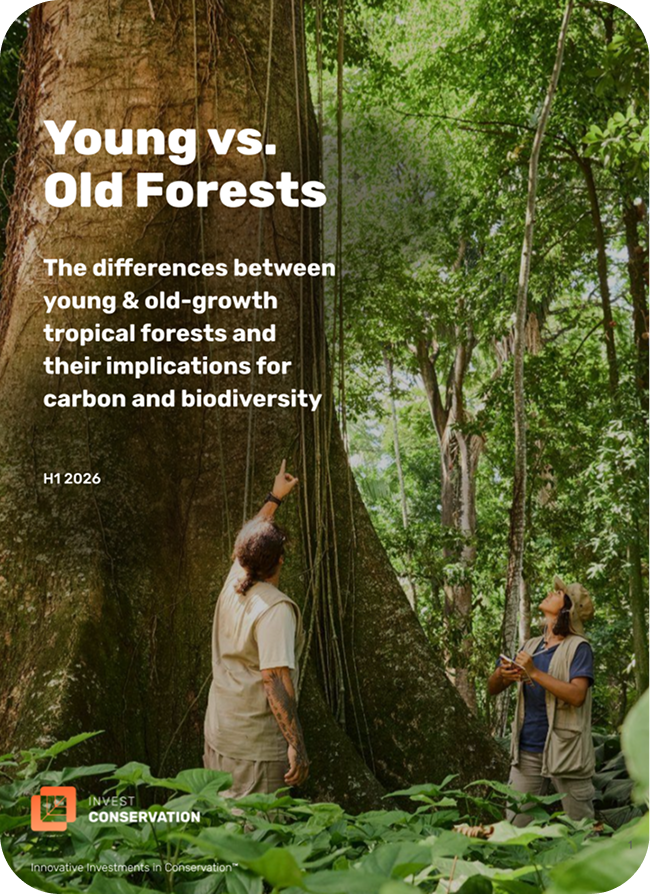
The differences between young and old-growth tropical forests and their implications for carbon and biodiversity.
Both forest restoration and conservation of standing forest are needed to mitigate climate change. Yet most climate finance prioritises reforestation, leaving conservation of mature tropical forest underfunded, despite the carbon sequestration role mature forests provide.
This imbalance partly stems from a theoretical paper published in 1969, which led to the misconception that mature forests are carbon neutral and young forests remove more carbon.
Advances in research and empirical data show this is not the case. Old forests are not carbon neutral; they are, in fact, net carbon sinks that continue to sequester and accumulate carbon for centuries.
Mature tropical forests:
Store 3× more carbon than forests under 20 years
Accumulate 39–50% of lifetime carbon in the last quarter of life
Individual large trees can add as much carbon in one year as is contained in an entire medium-sized tree
Forests with a robust animal population sequester 4× more carbon
By contrast, young forests can be a net carbon source for at least the first decade.
In most cases, it is more cost-effective, carbon-effective, and biodiversity-effective to keep a mature forest standing than to try to regrow it.
Download the overview to learn how forest age shapes carbon dynamics.